
Nothing
hidden.
Nothing
unverified.
Every claim we make has a source. Every batch has a test result. Every environmental statement has a peer-reviewed study behind it. This page is where we prove it.
Page last verified:
What we say, and why we can say it.
We make five core claims about Albae. Each one is backed by peer-reviewed science or third-party testing.
Your product, verified.
Every bottle of Albae has a batch number printed on the base. Enter it below to see the full Certificate of Analysis for your specific batch — exactly what was tested.


Why we test every batch
Most supplement brands test occasionally. We test every batch, because your health depends on consistency — not averages.
Our CoA is issued by an independent, NABL-accredited laboratory. We do not test in-house. We do not select which batches to publish. All results are published.
"Albae will never use ocean-harvested ingredients. This is not a target or an aspiration. It is a permanent, unconditional commitment built into how our product is made."
— Albae founding charter
Real numbers. Not estimates.
Shaivaa Algaetech — the company behind Albae — completed its first verified carbon footprint assessment for FY 2025–26 using the SME Climate Hub Small Business Carbon Calculator. Here is exactly what we found.

Scope breakdown
94% of our total emissions are Scope 3 — supply chain and capital investments — not from our own operations. Our direct operational footprint (Scope 1+2) is just 1.968 tonnes CO₂e.
Emission sources compared


Plastic neutral: collecting plastic equal to our usage.
Our softgels come in plastic bottles, and our orders ship in packaging. So every year we estimate how much plastic we put out, and fund the collection of at least that much from the environment through Plastic Collective, using credits certified under Verra’s Plastic Waste Reduction Standard.


Four steps, checked every year.
We estimate the plastic in our bottles, cartons and shipping packaging for the year, based on forecast sales.
We buy a Verra-certified Waste Collection Credit through Plastic Collective: one tonne of plastic collected that wouldn’t have been otherwise.
The credit is retired on the Verra Registry with Shaivaa Algaetech LLP (Albae) as the owner, so no one else can ever claim it.
Plastic Collective checks our actual sales against the credit. We buy more before we pass 10,000 products.
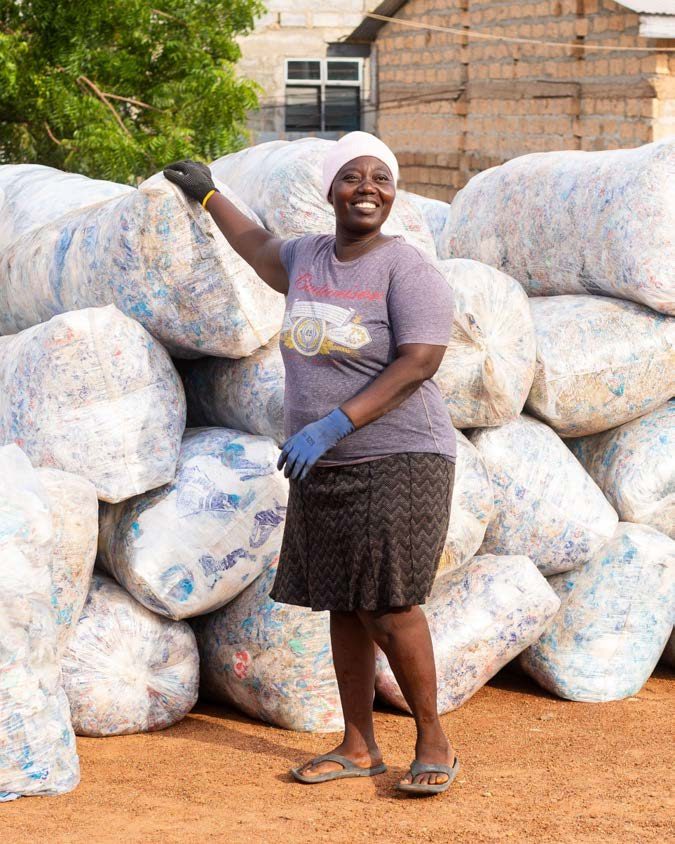


ASASE Foundation, Ghana.
ASASE collects plastic waste in Ghana, one of the world’s plastic pollution hotspots, and sends it to recycling. It is Verra project #3964, and it holds three certifications.

Look it up yourself.
Every plastic credit has a unique serial number on the Verra Registry. Ours was retired on 13 October 2026.
What this does, and doesn’t, mean.
It does mean
- At least as much plastic as we estimate we use is collected from the environment and sent to an acceptable end of life.
- That collection wouldn’t have happened otherwise, and it’s counted for us alone.
- Collectors on the project are paid fairly and work in safer conditions.
It doesn’t mean
- That our bottles are plastic-free or made from recycled plastic. They aren’t.
- That our own bottles are the ones collected. The credit funds collection of an equal amount elsewhere.
- Anything for our carbon footprint. Plastic credits are not carbon offsets; we report carbon separately.
- That our footprint figure has been audited. It’s our own estimate. Plastic Collective hasn’t checked it in depth, so any error in it is ours.
The full disclosure, word for word.
This is the text Plastic Collective approved for our claims. We publish it in full.
Read the disclosure ↓
“As part of our Plastic Impact Plan to use plastic better, Albae has partnered with Plastic Collective, a leading global player in creating circular economies for plastic and in certifying plastic waste reduction projects under the Verra Plastic Waste Reduction Standard, the ZPO Social Plus Standard, and the ZPO Ocean Bound Plastic Standard. Through this partnership we identified the following certified plastic waste management Project from which to purchase plastic credits:
ASASE Foundation Ghana Project https://asasegh.com/ (Ghana) Verra #3964
Through this credit purchase, Albae is investing in the plastic waste collection activity being undertaken by the above Project in one of the world’s plastic pollution hotspots.
Albae has purchased 1 Waste Collection Credit (WCC), representing 1 tonne (1,000 kg) of plastic collection, for the period 1 October 2026–30 September 2027. The credit was retired on 13 October 2026, with the following Verra Registry serial number:
The credits that Albae has purchased represent 1 tonne of plastic that has been removed from the environment that:
- would not have happened in a business as usual scenario;
- represents plastic going to an acceptable end of life; and
- are attributed solely to Albae on the Verra registry.
In addition, the above Project is certified under the ZPO Ocean Bound Plastic Standard. Albae is therefore supporting a project that is collecting mismanaged plastic from waterways and / or oceans within a 50 km radius of the Project’s operations.
Furthermore, the above Project is certified under the ZPO Social Plus Standard. Albae is therefore supporting a project that is working to improve the livelihoods of its waste pickers through:
- the payment of a minimum 10% premium above market price for collected material;
- the provision of routine healthcare, empowerment opportunities, PPE, and a safe working environment; and
- the elimination of child labor.”
About our plastic.
What is a plastic credit?
A certificate for one tonne of plastic collected or recycled that wouldn’t have been otherwise. Each has a serial number on a public registry, and once it’s retired in a company’s name nobody else can use it.
Why is the credit’s collection period 2021–22?
Credits are issued after the collection has been carried out and audited, so a credit always refers to past collection. What matters is that it was retired for us alone, for our claim period of October 2026 to September 2027.
What if you sell more than you forecast?
Our credit covers up to 10,000 products. Plastic Collective checks our sales every year, and we buy more credits before we pass that number.
Is this the same as carbon offsetting?
No. Plastic credits fund plastic collection. They don’t reduce or offset carbon emissions, which we report separately.
The evidence behind our health claims.
We only make health claims that are supported by peer-reviewed science. Here is every claim we make, and the study behind it.

| Claim | Evidence summary | Source | Status |
|---|---|---|---|
|
DHA DHA supports brain health |
DHA is the most abundant omega-3 fatty acid in the brain, contributing approximately 97% of brain omega-3 PUFA and 93% of retinal omega-3 PUFA. It is a key structural component of neural tissue and membranes. | Li et al., 2021, Food Science & Nutrition | Verified |
|
DHA Algae DHA equals fish oil in bioavailability |
Algal-oil supplements are a viable alternative to fish-oil supplements in terms of DHA bioavailability and absorption rate. | Ryan & Symington, 2015, Journal of Functional Foods | Verified |
|
DHA Algae DHA: 30–40% lower carbon than fish oil |
ISO 14040/44 LCA study comparing algae omega-3 DHA with fish oil found 30–40% lower climate change impact for algae-derived products at industrial scale. Industry-level comparison — not Albae's own product-specific LCA (in progress). | Davis et al., 2021, Algal Research | Verified |
|
Astaxanthin Astaxanthin reduces oxidative stress markers in humans |
In a randomized, double-blind, placebo-controlled trial, dietary astaxanthin (2–8 mg/day for 8 weeks) significantly lowered a key DNA-damage biomarker (8-OHdG) and reduced plasma C-reactive protein, indicating reduced oxidative stress and inflammation. | Park et al., 2010, Nutrition & Metabolism | Verified |
|
Astaxanthin Astaxanthin supports skin health by reducing oxidative damage |
A 4-week study in 31 middle-aged adults found continuous astaxanthin intake (4 mg/day) reduced plasma malondialdehyde (a marker of oxidative stress) by up to 21.7%, alongside measurable improvements in skin surface aging markers. | Chalyk et al., 2017, Nutrition Research | Verified |
|
DHA Algae DHA: no ocean contaminants |
Land-based closed fermentation systems eliminate exposure to mercury, PCBs and dioxins found in ocean-sourced fish oil. | Batch CoA — see above · Third-party NABL lab | Lab tested |
Commitments with dates, not intentions.
Vague sustainability promises are easy to make. Here is exactly what we have committed to, and when.
- Publish CoA for every batch publicly Active
- Carbon baseline via SME Climate Hub Done ✓
- Cite all health claims with sources Done ✓
- Publish first Impact Report Active
- Launch this transparency page Done ✓
- ISO 14044 product LCA Planned
- Join 1% for the Planet Planned
- 100% recyclable packaging Planned
- Supplier code of conduct Planned
- Second annual impact report Planned
- ISO 14067 carbon label on pack Planned
- B Corp certification submission Planned
- Net zero roadmap published: SBT-aligned reduction pathway Planned
- Third-party verification of Scope 1–3 inventory Planned